
Teaching Kids to Think Well
Summary
In a talk to the Turning Point Education Educators Summit, Dr. Firestone teaches 'not what to think but how to think,' using the Firestone dinner table as a model of Socratic dialogue, Kant's 'self-incurred tutelage,' and a proof that time does not exist to raise the intellectual bar with kids.
Show notes
In episode twenty-seven, Dr. Firestone shares a talk he gave the Turning Point Education Educators Summit several years ago. He discusses teaching kids to think like philosophers, drawing on the likes of Socrates, Descartes, and Kant, and using his practical experience cultivating a culture of deep thought with his own kids.
The Firestone Files: Letters to My Grandchildren is a podcast hosted by Dr. Chris Firestone. In it, Dr. Firestone uses his expertise in philosophy and worldview to bring answers to profound questions to bear on the mundane of life through personal anecdotes and family stories.
Transcript
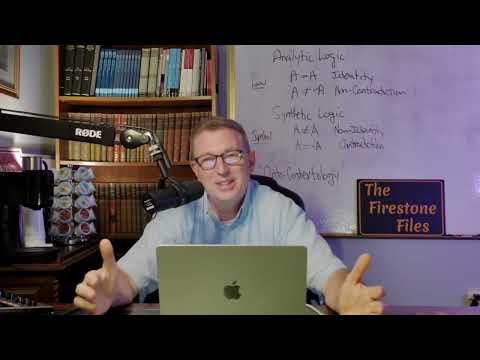
Today I have a special presentation I did some time ago on thinking like a philosopher. Hey everybody, welcome to the Firestone Files. I am Dr. Chris Firestone. Today I have a special presentation I did some time ago on thinking like a philosopher. This was for a TPUSA event. Uh an educator summit had a whole mess of educators in there and all sitting at round tables and you're going to hear me pontificating talking about the theme not what to think but how to think. that is how to think like a philosopher. So I'm going to draw on principles from Socrates, Deart, and Kant. I'm going to utilize the Firestone family dinner table as an example of Socratic dialogue and how to think.
And then we're going to conclude this uh presentation by breaking them into groups and have them read some of the great texts and dialogue about them and then report back their findings. So, that's all coming at you today on the Firestone Files. I hope you enjoy it. Well, isn't Hut something. My what a congenial guy. What a great introduction that was. I really don't deserve it, but thank you, Huts, for that. Um, as far as Alex, there nothing a philosopher hates worse than giving all the answers before the test. And that's what the theologian seemed to do in the first presentation.
Uh, but we're going to we're going to uh take a step back into the world of philosophy. Um, one of the things I like to do with my classes, you I'm the guy responsible for those sheets of paper that are on your tables. I know that you you're probably like me. You like to take notes and so forth. You won't need your cell phones to take any pictures because we're going to do some thinking together here today. Okay, thinking don't really need to uh, you know, embive any information. We're just have a conversation here together. Um, and I thought those sheets would help you to just take some notes if you want.
Uh, and we can go from there. All right. Well, um, you can see here that, uh, you know, whenever I'm teaching a group of students, I usually try to start with some kind of question to gauge where they're at intellectually. So, I thought I'd start with you with a question I often use in my introduction to philosophy class. Consider the following syllogism. All convicts are people who have committed crimes. Sam is not a convict. Therefore, Sam has not committed a crime. What do you guys think? Is that a valid or an invalid argument?
Invalid arguments. Okay, this is a sharp crowd. I can see that. Now, the question is, why is it invalid? He may not have been caught yet. He He may not have been caught yet. Okay, thank you so much. Yeah. You know, you know, one of the most common answers I get is usually to turn away from the life of the mind to the real world. Not unlike what just happened here, right? To the real world. Oftentimes students will say things like, "Well, it's obviously not true that all convicts are people who have committed crimes. Certainly, there are people in jail who haven't committed a crime.
That's not a valid argument." Well, philosophers, particularly logicians who are concerned with how to think, we don't care whether or not there is in fact persons in jail who have committed crimes. It is invalid not because of what we think, but because of how we think. I've said nothing about people who are not in jail. So, when I say that Sam is not a convict, I've not said anything in my premises about whether or not he's committed a crime. Therefore, it's invalid. has nothing to do with the actual material truth of the claim. It matters more how we think than what we think. And that's what I want to talk about here from the point of view of philosophy this morning.
Okay? Is to talk a little bit about that. So what's the game plan here? I'm going to kind of buzz through the first three points because I really want to get to the uh point four. Have a brief introduction about myself. We're going to talk a little bit about education today. So many speakers have done such a great job on that. So, I'm going to go fairly quickly through that material and then we're going to look at a brief history of philosophy. And when I say brief, three slides brief, and then we're going to get to what I really want to do with you guys, and that's learn how to think together by looking at three philosophical lessons together.
Does that sound good? And hopefully, if we get time, we'll get to this last point, which is the relationship between philosophy and faith. So, I'm going to try to bring it back around to the relationship between theology and philosophy by the time we're done. Does that sound like a good plan? Okay. Well, let's let's uh let's get started. Now, one of the things I want to do here just to help me is I'm going to break up all of these tables into four categories.
We're going to name you guys. So, since Hutz is over here, I'm going to call that the Socrates group. So, let's say these six tables here on this side by the wall, you're the Socrates crowd. Okay. The next group here, we'll make you guys the Decart crowd. Maybe these uh five tables or six tables right here. That sound good? Decart. Uh this group here, I'm going to make you guys the crito the crito table. These six tables here. So when credo comes up, you'll know that you're uh sort of obligated to participate. And then when we go over here, you guys will be the youthro youthro crowd.
Does that sound good? Okay. So just just so I can remember when we get to those points, you guys can help me u to have a little more dialogue and a little less monologue. Okay? So we'll see. We're going to have some mic runners around here as well. So hopefully you guys can participate with me. Okay. Um our objective is that you will walk away from this talk with practical strategies to help children in your classroom develop critical thinking skills. So that's really what I want to get to is some real practical suggestions for you guys who are educators. primarily I think K through 12. Would that be fair?
Um, in that group. So, that's what I'm going to try to focus on is bring philosophy to that particular group. Okay. Well, um, you can see here, I think H did a great job. I've been a professor of philosophy for more than 20 years. You can see uh that I teach everything. When you teach at a Christian liberal arts college, a smaller college, you end up teaching almost every course in the field of philosophy. So, in one sense, I'm a generalist. In another sense, all my publications or a good majority of them have been in the area of the philosophy of Emanuel Kant. And the philosophy of Emanuel Khan gets kind of a it's a kind of a mixed bag.
Some people think he's, you know, pro-Christian. Some people think he's anti-Christian. We'll talk a little bit about that as we go along. I'm married to an elementary school uh educator. Truth be told, she's actually more of a homeschool teacher. She stopped teaching about after about three or four years of teaching in elementary education and she moved into teaching our five kids. And the one thing I love about this picture, you can see our five kids. This is the finished product. We're going to look at some earlier times in our life together and look at how philosophy has impacted that. We also have a sixth child now who has married into the family. I'll let you guys figure out which one it is.
Okay. It's the guy on the left. Okay. Matthew. We now have two Matthews in the family. My oldest son and of course my grafted in son uh Matthew. Okay. Uh challenges to life of the mind today. So here we're talking about education. Some of these points you guys have already talked about so I won't belabor them too much. Education is seen as instrumental. And by that I mean people look at it as a means to an end. They don't look at it as having intrinsic value. that you need to dwell in it for a while, right? Worthwhile endeavors, however, take hard work and they take time.
I don't know if you've seen this book by the uh by the Harris uh brothers, do hard things. Young people want to do hard things, especially if you catch them young and you let them know that it's worthwhile. They'll see education not as an instrumental means to an end, but as something that actually helps them to flourish as individuals. Uh, education is fast and furious. We have too little patience. When you see it as instrumental, you just want to get through it. I think parents are probably, and truth be told, some of the worst uh sort of perpetuators of this particular myth.
They want to know when they come and see me and they find out their students a philosophy major. Say, "What's he gonna do with that? Have you have you thought about that? Is that is that your worst fear that your kid will come home and say he's a philosophy major?" Um well, philosophy is if one thing is about getting into texts and taking your time, right? One of the texts I have here is the book of virtues. Some of you guys probably know this. This is a book that was recommended to me by a theologian years ago, the book of virtues. It's kind of a thick book, but it's a great book because I read it to my kids growing up.
And uh so many of the virtues are highlighted by great stories over the last 2,000 years, even some biblical stories, some non-biblical stories, and so forth. Highly recommend this book. So significant was it to our family that my kids all signed it when they left home and they wrote out what their favorite story was in the book because we to discuss those things together at nighttime. And uh sometimes I make up stories, but very often this would be kind of a grounding text for it because it celebrates the virtuous life.
Now in our talk here today, I'm not going to focus that much on virtue. I'm going to talk focus more on the logical side of things about how to think. But the life of virtue is also obviously very important. Education is entertainment. I think we've heard a few speakers talk about that. We consume rather than participate. Real learning involves listening and responding imaginatively. Has anybody seen Dead Poet Society? What an awesome what an awesome film about a teacher who's inspiring his students to listen and to respond imaginatively. So hopefully we can do a little bit of that together here today. Education is technology. We're all now learning to think via AI.
It used to be we all all we had was Google. Google it. I had that problem when Google started to come up in the classroom. They would always fact check me. You know, the teachers don't like that. Okay, we use hyperbole now and then. You know what I mean? Uh they fact check you. Now we have this AI thing that's giving us all the answers to life's questions. We should become thinkers, not intellectual managers. One of the temptations that AI is going to bring to us is that we just learn to ask better questions and try to get that. That's an important skill, but you do need to come up with answers yourself. Use synthetic reasoning, be creative, learn how what what a good argument looks like, how to stake a claim, and how to give reasons for it. All of that is a skill that we need to teach our young people and not just become reliant upon AI.
Education is culture. We are told what to believe. I think one of the points of Pete's Hegath's book, got a chance to meet him at the last conference. That was so much fun. That's one of the great things about these conferences. You meet people you only saw on TV. Okay. Um Pete H says, "What a great guy. He wrote that book uh the battle for the American mind." And he's talking about this whole notion of culture. I think he uses this more fancy Greek word called Pideia. And that really is culture, but it's kind of culture on steroids. Kind of like the life world that we inhabit.
When we get together like we're doing in this conference, we speak a certain language. We inhabit a certain life world. And it either resonates with truth or it doesn't. Right? And we need to take hold of those cultures as it were. Uh we are and not just be told what to believe but we need to be told how to think not what to think. And that's really what I want to talk about here this morning. Now as I said before I'm a K scholar and so I see everything from in philosophy from the point of view of Emanuel Kant. And here's what that looks like in my mind.
Yeah, I don't know if you can see this. Oh, and I got this. This is pretty cool. I got a manual con up here at the top. And see who thought of the two screens here. It's either brilliant or the stupidest thing I've ever seen. I'm not sure which one it is. I think it's brilliant. There's Emanuel Khan at the top. And here's all the philosophers that follow Emanuel Kh in the 19th and 20th centuries.
It's complicated. It's complicated. There's a lot of philosophy out there. How do we make sense out of all of these various movements? The 21st century is even worse than it was previously. There are a lot of different worldviews out there. There are a lot of them that are interacting with Christianity. How do teachers hope to make some sense out of it? One of the books, I don't have the picture of the book up there, but one of the books that's been influential to me as a as a philos philosopher, Francis Schaefer. Yeah, thank you so much. Yeah, Francis Schaefer did a great job of sort of organizing our ideas about the history of philosophy.
So, I'm going to give a a brief picture here of how he saw this movement. There's the 18th century. At the at the end of the age of reason, we see some philosophies that look familiar to us. Empiricism, rationalism. Well, maybe these ones at the bottom don't make a lot of sense to us. Empiricism has to do with all knowledge coming through the senses. Rationalists say knowledge comes through the senses, but it also is buried within reason. Opriori prior to any sensation.
Common sense realism of Thomas Reed. Transcendentalism is Emanuel Kant. We could do a whole course there. You know, philosophers are pretty spontaneous. Should we just do con? No, no, no, no. We can't do that. Well, let's move on. Uh, so 18th century philosophy, the age of reason is still what I would call relatively Christian friendly. All of the thinkers who gave rise to these systems are not obviously anti-Christian in any noticeable way. But by the time we get to the 19th century, we see a tilt starting to happen. And Francis Schaefer says that this line of despair happens when logic, the law of non-contradiction is broken and replaced by what he calls synthetic logic.
Now Kant invented synthetic logic, you might say. I don't think he invented but he he first noticed it and and and codified it. But it was a purely epistemic category for Kant. It was a way of describing critical think and creative thinking. But in the in the 19th century, it replaces the very essence of reality and in some ways replaces God as the fundamental driving force for ontology or the nature of reality. Reality itself argued the 19th century philosophers is synthetic somehow. It's thesis and anti-thesis coming together into a higher order synthesis. And that's what you get in idealism here.
The existentialists like Saurin Kirkugore and Friedrik Nichi they take a leap of faith they go beyond reason as it were and that's why he wrote the book escape from reason it's a great little book if you want a nice quick read about how to organize your philosophical thoughts get escape from reason like 45 or 50 pages long and it is really a helpful resource by the time we get to the 20th century you can also see phenomenology dialectical materialism that's another fancy word for Marxism In case you guys are interested in that, uh the 20th century saw some new movements. This is the rise of atheism.
We have logical positivism which says language is only meaningful if it has a one to one correspondence with something in our sense in our senses, one of our five senses. That view was quickly uh uh eradicated, but it was replaced by other views like secularization. You guys will probably know that our public spaces are being whitewashed of all religious content or at least they had been throughout the 20th century. That's because of the secularization movement. Leo Strauss went back and he said, "Look, we should have a such a separation between church and state that nothing remains of the religious in our public spaces." Same thing is was happening in the 20th century in the world of ideas. They started revisionist histories where they looked back at earlier periods and showed that those those writers were really against God against Christianity.
They and they gave esoteric readings of those earlier historians. So in the 20th century we have the age if you will of the revisionist history where they start to rewrite history and see it in a non-Christian manner. By the time we get to the 20 uh 21st century, you guys probably know where we're going from here. Philosophy has kind of turned itself completely upside down. It is not that postmodernism is bad. In fact, postmodernism has some really good categories for some really good opportunities for Christians because what postmodernism does is invite everybody to the table for a conversation. The only problem with postmodernism is there's no litmus test of who who can't speak.
Everybody can speak and they all speak at the same time. And we're supposed to value all those positions as if they were created equal. We have uh murological universalism, critical theory, atomistic individualism. These are some of the things that you're now seeing on the marketplace of ideas. We're not going to have time to go in. There's going to be a whole course on that alone. So, we're just going to press on. I'm going to take a few step backward here. That's a complicated story.
What is philosophy? What is philosophy? So I want you to guys to take one minute at your tables, that first column, what is philosophy? When you when you meet a philosopher, you think of philosophy, write down a couple of words that come to your mind when you think of philosophy in that first part and uh maybe mention them to people at your table there. All right, I'm going to give you guys one minute. When you think of philosophy, what do you think of? If you meet a philosopher, what do you think about those people? If we can get those microphone runners to around so we can hear back from some people, that'd be great. If you got a spokesperson at your table, maybe we can get one or two. We're not going to have time to cover everybody. When you think of philosophy, what do you think of a philosopher or philosophy? You know, what words come to mind?
All right, why don't we bring it back, guys? Let's let's uh let's share a couple of time. Just pop your hand up if you've got a word that comes to mind when you think of philosophy. There we go. Yeah. Uh someone in our table said, um deep thinker. I said critic. Okay. Deep thinker. Absolutely. Philosophers, they they kind of scare us a little bit because we know if we're we're with a philosopher, they're not going to let what you say stand, right? They're going to hairsplit. They're going to think more deeply about it. I don't really want to think that deeply about things, right? They're definitely deep thinkers, but there's deep thinkers in a lots of fields, right?
And so it doesn't it's not peculiar to philosophy, but it is definitely a characteristic of philosophy. Yes. Overthinkers. Overthinkers. Oh, that's a qualitative judgment right there. I one one of the to that point um one of the things I uh I started partnering with some students to write books over the years and I've written a number of co-authored books with with former students and one of the main characteristics about these former students that I appreciate most is those guys and gals who don't settle who don't settle. So, I write a book or I write a I write an argument and they look at it and they go, "Well, that's not right.
You need to clean that up, right? They're not going to settle." And I get frustrated sometimes cuz they overthink it. And I go almost to a person, I have never been disappointed in the end by being pressed more deeply into my arguments. Okay. So, you're right. They do overthink it, but they the good philosophers, they they're they they they strive for excellence in our thinking and they don't let this the status quo stand pat without being improved. Yeah. Maybe one more here. What do we have? Wisdom. Wisdom. Yeah. Uh you know, Phileo means brotherly love and Sophia means wisdom. It's like the etmology of the term, right?
The lovers of wisdom. And I do think that good philosophy is about seeking after truth, beauty, and goodness and loving those things that oftent times we take to be more important than even life itself. I'm not going to die for whether or not this table or chair exists, but I might die for my dignity or for love or for justice. And wisdom, I think, is the quest to better understand why that's the case. What is it about ultimate reality that would make those things worthy of dying for? So, thank you.
Thank you guys so much for that. We're going to press on here. Uh my philosopher Emanuel, you know, there are a lot of definitions. You look up in a book about what the definition of philosophy is. There's a lot of them out there and I'm not partial to this. I guess I am. Emanuel K gives us the very best definition of what philosophy is. And once you hear it, you can't unhear it. Okay? uh it just becomes part and parcel of your toolbox as educators once you hear this thing. Okay. Philosophy is the perspective of the self based on reason and freedom. The perspective of the self based on reason and freedom.
You know you're doing philosophy when you're not appealing to another authority. We heard earlier from the theologian appealing to the authority of the Bible. That's our endgame perhaps. That's where we want to lead a student's never heard before. But you want to begin by telling me what you think from where you stand. I don't want to know what Paul thinks. I want to know what you think. And that's where philosophy begins. When you tell us what you think from where you stand and give reasons for it, you're doing philosophy. When you're appealing to other authorities, you might be doing theology, you might be doing psychology, you might be doing medicine, you might be doing sociology, have textbooks.
Yes, they do. And uh those are other authorities. And by the end of this lecture or this conversation I guess we're having here together, I'm going to suggest to you that wisdom bids us, good philosophy bids us to trust other authorities that are wiser and smarter than us. And that's the beginning of wisdom right there. But it all begins with you learning to think for yourself. Okay?
So you know you're doing philosophy when you share what you think from where you stand. When I deal with students, one of the biggest things I have is they tell me what somebody else thinks about an issue. I raise a question. I don't want to know what somebody else thinks about the issue. I want to know what you think about the issue. Now if what you think about the issue happens to correspond with what somebody else thinks about the issue, then you ought to say as much. Okay? But that's one of the biggest issues I find with students is that they're not free thinker. They're not thinking for themselves.
are telling me what everybody else thinks. But do you know that they believe what those other people think? Do you know what they really believe? Philosophy is concerned with that. It's con concerned with sort of maturing them, growing them unto wisdom. Okay. So what are some of the potential problems with this? This is not immune from difficulties. As a Christian philosopher, I kind of know this, right? When you bracket off other authorities, there's risk involved. What's the problem with the perspective of the self? Why don't you take about 30 seconds here with each other? What's the problem with Firestone's definition here via Emanuel Kant of philosophy is the perspective of the self based on reason and freedom.
All right, I'll give you 30 seconds to talk to each other. What's wrong with this view of philosophy? I'm very curious about this one. If anybody's got an idea, pop your hand up and maybe we can get uh here. Right in the back here, Scott, right next to you. What's wrong with this view of philosophy? It does not acknowledge the knowetic influence of sin. Oh, I love it. The knowetic influence of sin. Noetic meaning that life of the mind is corrupted by the ways of the world. Absolutely. I think that's a great one. A Christian worldview would certainly hold such a thing. And there are good philosophers who would agree with the Christian worldview on this very point.
By the way, Emanuel Kant's one of them. All right. Anybody else? What's another issue right here? There's no standard of truth. There's no standard of truth. Okay. Um, yeah, there's no standard of truth. Well, you know what? What? What's the implicit standard here? Reason. He's in the age of the enlightenment. Reason's the standard of truth. One thing that we would challenge as Christians is that reason itself might have some issues with it. Okay.
So, let's take a quick look here. What I one of the problems with the perspective of the self is that it's situated. You're in a particular place in space and time. You're an American. You're in Deerfield. You can't you don't have access to all truth, do you? Uh so it's situated. The perspective of itself is situated. Secondly, I would say it's shortsighted. All of us have a horizon. We can only see so far. We're not omniv uh omnisient in this sense. We can only see so far. And I think the one that uh you guys got pretty well, it's saddled with a weak will. It's not only saddled with a weak will, but it's itself has been infected.
It it has a it has a potential problem with it. So there's at least three problems here with philosophy. So defined it's needy. It's going to need help. It's going to need authorities other than itself to to find the the answers to the big questions of life. Okay. So, how can philosophy help us? I'm going to make the argument here that learning how to think happens best when we work hard to develop a culture at home and in school that values and enhances the life of the mind.
Additionally, we can use philosophical principles to help us in daily life by teaching to impart critical thinking skills to children in an age appropriate manner. So, that's where I'm going to try to get us here this morning. Um, okay. Our context for my brief comments here is the kitchen table. Anybody have a kitchen table here? I mean, it's not just the kitchen table. Translates pretty well to your schoolroom tables. And thank you, Huts, for putting these tables together. This is You really couldn't do better for me than this. The kitchen table. Our kitchen table was a lively place. 95% of our homeschooling happened by mom from 9 to5 and then dad would show up at the kitchen table and that was his turn to contribute.
How did I contribute? I contribute at the kitchen table through a kind of dialogue. And so I'm going to use this as my primary example. Some of the basic rules that I like to instill in myself as a leader of this table time conversation. Be truthful. Be affirmative. Raay the bar, make it organic. You want to be in the truth. You don't want to shut down dialogue. You want to constantly stretch their understanding. So by raising the bar intellectually at the table and maybe the secret sauce of this whole thing is making it organic. You don't want it to feel forced. So maybe it doesn't happen every time. Maybe it happens because of something that has come up in conversation and suddenly you break into it. There are ways of doing it's more an art than a science in some ways. Okay?
And so you want to uh have these sort of basic rules in mind. The preparation, you want to think in advance. You want to prepare questions, check your answers, and know your audience. You want to have some tools in your toolbox for how this is going to be done. So the three lessons in philosophy that we're going to apply at the kitchen table are uh are these from Socrates. Learn to be inquisitive. yet optimistic. Sometimes questions can lead to no answers, pessimism. No, we're optimistic. I think that's something that we learned from Socrates that we can actually get to answers to questions in life. From Decart, be skeptical.
One of the things that philosophy teaches us, I think, initially here is that when you hear an opinion, it's probably not worth much. yet be constructive. Build ideas into systems of thought and from Kant be independent yet critical. Kant's all about free freedom in thinking and he's all about taking disparit ideas and creating higher order worldviews from them. So be a person on the move developing your thought, creating lifelong learners. If we get time, I'd like to add a That's why I put three plus lessons. There's a lesson from William James here, great American philosopher in the early part of the 20th century.
Be practical but believe. So hopefully we can get there together. Okay. So first lesson uh number one here is from uh Socrates. Be inquisitive yet optimistic. The Socratic method. You guys are all familiar with the Socratic method. It looks sort of like this. There's a main character. Usually that's you, the teacher. And then there's secondary characters in your classrooms around your table. There might be four or eight. There might be 20. In this case, there's 200. Okay. Uh, and I guess I'm going to be Socrates. Well, we we'll see how this happens. If if uh Where's the Socrates group over here? I need somebody who's going to be a reader who will be Socrates.
Okay. Where's the Where's these microphones at? I'm I'm lost. Oh, here we go. If somebody want to do the reading for me, it's on the back of the page that you guys have. We're going to try a little reading here together. Oops. This is the wrong one. Actually, don't have a copy of this myself. Let's see. Thank you so much. Okay. Do we have a Socrates over here? Do someone pop their Okay, great. And then we also need a uh youthro. That's somebody over here on this side. Oh, well, here we go. Right here.
All right. Why don't you guys take that and and read it for now? Let me set the stage for this. This is um this is at the courthouse. Socrates has been called to court. He's put on trial. He says he's been corrupting the youth ma the youth making the worst appear the better cause. He's explained that Mitus has taken him to court. He he he can't believe that he's been taken to court, but he explains that situation. And then he turns to youth to ask him a few questions. So let's go ahead and start with uh youthro first. Perhaps it will come to nothing. Socrates and you will fight your case as you think best as I think I will mine.
What is your case you bro? Are you the defendant or the prosecutor? The prosecutor. Whom do you prosecute? One whom I am thought crazy to prosecute. Are you prosecuting someone who will easily escape you? Far from it, for he is quite old. Who is it? My father. My dear sir, your own father. Certainly. What is the charge? What is the case about? Murder. Socrates. Good heavens. Certainly, Uthifro. Most men would not know how they could do this and be right. It is not the part of anyone to do this, but of one who is far advanced in wisdom.
Yes. By Zeus. Socrates. That is so. Is then the man your father killed one of your relatives? Or is that obvious for you would not prosecute your father for a murder of a stranger? Thank you guys. Hey, let's give him a hand, would you? That's pretty good reading. I mean, I wouldn't I wouldn't say it's trivium quality, you know. It's rhetoric is a is a tough skill to learn, but it's pretty good. Okay. Uh we uh we see here a strategy from Socrates. He's getting to know Uther. What does he do first? He asks some basic questions about Socrates. You might call these questions a fact.
He's trying to get to know him, what the situation is. What does he discover about Uthifer? He's a prosecutor, right? He's taking his father to court. Socrates can't believe this. Who in the world would take their father to court on murder charges? And the whole dialogue ensues from there. And Socrates makes an interesting case towards the end. He says, "Well, uh, is then your the man that your father killed one of your relatives or is that obvious for you would not prosecute your father for a murder of a stranger?" Socrates sees a distinction between a murder case that would include family and a murder case that would include strangers.
In contemporary philosophy, call that the difference in ethics of care. That we seem to have more responsibility for people who are closer to us and murdering them. uh would be a case that might prompt Uthifer to make his case. And yet right after this is appalled by this question because justice is completely blind and and he says that and and Socrates says well you must be a very wise man. What does Uifro say?
Why yes I am. I am a very wise man. So Socrates is going to take that opportunity to question him for the rest of that essay. quite a fascinating it's one of my favorite Socratic dialogues because it's such an unbelievable story. It's such an interesting story. Okay, so that's uh that use questions and conversation get get things going. Okay, uh the next point here is find the right people in Uthifro. The whole reason they've written it is because he's found the right person. Uhro is presumably a guy who knows what piety is and what justice is. He must know what it is because he's prosecuting his father.
So, Socrates is going to take the time to really probe this person because he must know what justice and piety really are. Okay. So, he wants to find the right person. Now, let's go to uh can we get another Socrates over here? We're going to need another Socrates. And then we need what? We're on the crito reading now. Where's CTO? Critos. Yeah, we got a group in here. Anybody right there? Man with the hat on. Is that Oh, yeah. Thank you. That'd be great. Let's Let's uh read this a little bit together. It starts with Socrates.
Uh now this credo dialogue credo is a is a dialogue where Socrates has been he's been charged. He's been uh he he has been found guilty. He is waiting in a house for his execution and young Socrates is there having a one last conversation with him. And so here we are with Socrates. Go ahead Socrates. You, as far as a human being can tell, are exempt from the likelihood of dying tomorrow. So the present misfortune is not likely to lead you astray. Consider then, do you not think it a sound statement that one must not value all the opin opinions of men, but some and not others, nor the opinions of all men, but those of some and not of others?
What do you say? Is this not well said? It is. One should value the good opinions and not the bad ones. Yes, sorry. The good opinions are those of wise men, the bad ones those of foolish men. Of course. Come then, what if statements such as this? Should a man professionally engage in physical training? Pay attention to the praise and blame and opinion of any man or those of one man only, namely a doctor or a trainer, to those of one only. He should therefore fear the blame and welcome the praise of that one man and not those of the many.
Obviously, he must then act and exercise, eat and drink in the way of the one, the trainer and the one who knows, thinks right, not all the others. That is so very well. And if he disobys the one, disregards his opinion and his praises while valuing those of the many who have no knowledge, will he not suffer harm? Of course. What is that harm? Where does it tend? And what part of the man who disobys does it affect? Obviously, the harm is to his body which it ruins. Well said. So with other matters not to enumerate them all. So here Socrates is making a very clear and I think wise distinction.
When you hear the opinions of the many or the opinions randomly chosen like we see on our television all the time where they meet people in the street and ask them for their opinions. What's Socrates knee-jerk reaction to that? Unhelpful. Unhelpful. You want to find a person and this is our point. find the right people and resources where wisdom can be found. And so when my students tell me comments like I think or in my opinion or it seems to me I ask well who are you? I immediately X out those words and say if you cannot say the rest of the sentence without hedging it with those initial comments like I think in my opinion it seems to me then get rid of the whole sentence. Speak the truth.
Don't speak opinions and if you don't know the opinions or you don't know the truth then start to read people who do know the truth. Okay. And so that's one of the things I think we see in Socrates. Choose your books and your sources wisely. Okay. Uh so that's another lesson from the Socratic method. Um have an eternal perspective is another one. One of the things I'm not going to read this one for the sake of time, but one of the things that we find in the apology is uh Socrates recounting a story about his his uh student that he sends to the oracle of Deli.
Um and his student asks the oracle of Deli, who's the wisest person in the land? And you guys probably know this. Who does the oracle say is the wisest person in the land? Socrates is the wisest person. And Socrates is mystified by this because he says, "I don't know anything. How could I possibly be the wisest person? And later on in that dialogue, he says, "Because you know that you don't know, and that makes you wiser than the rest." And then Socrates says something that I think is really a a poignant point that that we all need to to recognize about the the Greeks in general and Socrates in specific.
Who is who alone is wise? God alone is wise, says Socrates. God alone is wise. He's beckoning for a theological perspective on these matters because human perspectives are limited, situated, prone to a weak will, right? And so Socrates is looking for a divine perspective. This of course is what Christians capitalize on later when Christ comes some 300 350 years later, a divine perspective on the nature of reality. Okay. Um lastly, believe that the world is meaningful. One thing we see in the Socratic dialogues as Socrates argues for immortality because he sees virtue everywhere in this world. He sees the difference between great men and not so great men.
He sees everything testifying to the purposiveness of the world. And yet we die. And for Socrates that means there must be more to this world than meets the eye. You must believe that there's more. And we could go into that with Socrates. quite quite fascinating to see his arguments for immortality and so forth. It's not a crystal clear picture. It's going to take the return, the coming of Christ to clarify, the highest good, the way the world is actually going to unfold. But the Greeks understood that there's more to this world than meets the eye. Okay. So, how do you harness this around the table?
I'm going to suggest that you should use facts-based questions, not unlike Socrates does. Here's some topics for you. These are topics that I used around the table many, many times over the years. Mathematics, geography, astronomy, the Bible, books, history, around the house questions, lowhanging fruit for young people. Um, you want to read the crowd and mix it up. You want to know your kids. What are they studying in class? What are they interested in? And so forth. I usually start with the youngest kid with questions and work my way to the oldest. And there's a reason for that. I'll talk about that in a minute.
Use creative scoring methods. Give half credit. Use other creative scoring meth. Use soft competition might be some way of putting what I'm calling soft competition. You're the scorekeeper. You can keep it close. You can ask the questions. You can keep it uh you know balanced around the table. Do that. Be creative in your approach. Um split it into teams. If you have people who aren't being, you know, participatory, break them into teams, make it a little bit more collaborative, adjust to the groups. Topics may need to vary. And one of the things I think you got to have in your toolbox as a philosopher is play devil's advocate.
That is, you're going to get into deeper questions. You want to probe those things and keep the keep the tension in the dialogue so they continually think deeper about the issues. Okay? And I also put, don't be the devil's friend. You're not there to antagonize them. You're not there to to rub their face in a wrong answer or anything like that. You want to be the devil's advocate, not the devil's friend. Okay? When you're uh being philosophical. So, let me uh let me give you one example of this. Imagine you walked into this room. This is one of my pictures. My wife is homeschooling a whole mess of kids here or daycare in some cases or some combination thereof.
I walk in, in this case it's probably lunch, and I'm assessing the room. First thing I notice about the room is this young person right here. And then this old one here, that may be a freshman or something. I don't know. I think, okay, this is going to be good. Okay, this is going to be good. So, first thing I do is I throw a softball question to the youngest kid. What would I ask? Mathematics. How old are you? Every mother's teaching her kid to say how old they are. Oh, put your finger up. I'm one, you know. Okay, softball question. Hey, congratulations.
You got a point. All right, we're going to move on to the next. We're going to move on to the next kid. What's 0 + one? 0 plus one. What do you guys got? One. Thank you. That's one. Okay, you got a point. Congratulations for the What is this? The Credo group. Okay. Uh let's move on over here to this group. One plus one two two. Okay. Now you're working in the room. Everybody's tied right now. Man, you're building up. You're building momentum in the crowd. Say, "Man, this is a sharp group. It's a really sharp crowd. Let's keep going around the table." Okay. Uh next person.
Now they're starting to get a little bit older. We're going to move it up a notch. 2 plus three is what? What about Socrates crowd? 2 plus three. It's 2 plus 3 is five. Okay, thank you. Uh he's a good speaker anyway. Uh okay, we're moving up the 5 plus 7 is 12. Okay, thank you very much. Now remember, we're starting to move up the crowd here. We're getting to the bigger kids. We're going to Oh, here's a tough one. 19 minus 11. What did you say? I heard it. Eight. Okay, now we're to the biggest kid. And it's really important that you stump the biggest kid. Okay, so I ask a a tougher question. You know, teachers probably get the question right, you know, but the older kid might struggle with this one a little bit. What's the square root of 169?
I'm sorry. 13. 13. Is that right? Yeah. You're all wrong. Okay. That's terrible. You guys are teachers, aren't you? It's plus or minus 13. Yeah, the the kids always get this one wrong. Okay. The the bright kid sitting up straight. Sorry, half credit. My apologies. Okay. Okay. What's that going to do? The other kids realize game on. Even the oldest kid can't get them all right. Okay. So, it lowers the bar. They're they're they feel more involved and so forth. Big kids never going to make that mistake twice. Okay. Next time you're going to do what's the square root of 144? Plus or minus 12.
Okay. But it creates a dynamic in there that is really a healthy fostering of the life of the mind. Okay. Moving on to lesson number two. Be skeptical yet constructive. Skeptical yet constructive. I'm going to put this whole thing on the board for you here. The Cartisian method. Deard's a good Catholic philosopher very much interested in defending the Christian faith. In fact, he wrote the meditations on first philosophy to defend the Christian faith. And he wrote it and he sent it to theologians. He says, 'You don't see what's coming in culture, do you? You are about to be hit by a storm of philosophy, and I'm going to give you some tools in your toolbox that will help you to overcome that.
He's going to prove the existence of the self. He's going to prove the existence of God, and he's going to prove the existence of the external world. And by the way, you're going to need these things because what's coming is going to shake you to your very core. And this is all in the introduction to the meditations on first philosophy. And then he gets into it.
Engage your worst enemy. Is it Where's the Daycart crowd? Is that this group here? I can't remember. I can't remember. Yeah. Does anybody want to read uh text number three? Who's it? By the way, who's your worst enemy? Who's Decart's worst enemy? Yourself. Yourself. Well, that that's a deep philosophical. My goodness, this is sharp crowd. Um, one of the things when you're writing a paper or you're staking a claim, you always want to have present is your worst enemy. That is, you want to have the antagonist to your position in your paper. And why is that? Because you're not going to convince anybody that you're right if you're just speaking to the choir.
Okay? You need to have your opposition present. Decart knew this. If you're going to write a paper, you're going to stake a claim. Make sure your worst enemy is there. You're not going to convince your audience that you're on to something. Okay. Decart does this. Who's got that? Do we have a anybody in Deart would read this one? Right up front here. Thank you so much. This is text number three. You can start. Yeah. Right at the beginning there. I shall then suppose not that God who is supremely good and the fountain of truth. But some evil genius not less powerful than deceitful has employed the whole energies in deceiving me.
I shall consider that the heavens, the earth, colors, figures, sound, and all other external things are not, but the illusions and dreams of which this genius has availed himself in order to lay traps for my credul. I shall consider myself as having no hands, no eyes, no flesh, no blood, nor any senses, yet falsely believing myself to possess all these things. I shall remain obstantly attached to this idea. And if this by means it is not in my power to arrive at the knowledge of any truth, I may at least do what is in my power, suspend my judgment, and with firm purpose avoid giving credence to any false thing, or being imposed upon by this arch deceiver, however powerful and deceptive he may be. So, what does Decart invite into his deliberations?
The devil. Right now, he's not inviting the actual devil in. He's doing a thought experiment. Imagine some being so powerful that it could deceive me of everything I thought was true. What then could I know? What what would be the Archimedian reference point? That area that they couldn't deceive me of? They're going to get he's going to get to the famous Kito ergo sum in meditation too. The one thing the evil demon can't con can't can't fool me of is the fact that I'm a being that's capable of being fooled. Did you pick that up? This is what it takes to be primapaccia true. Soon as I start thinking about being fooled, I have to be a thinking being.
And so we're not going to read that that second reading, but that's his Eureka moment. His Eureka moment is the realization that even an evil demon couldn't fool me the fact that I'm a thinking being because I need to be a thinking being in order to be fooled. Stake a claim and give reasons for it. What he does in meditation two is give reasons for why that's the case. In meditation three, he then proves the existence of God from that point of view. In meditation four, he shows the veracity of reason for the task. In meditation five, he gives us another proof of the existence of God.
And then in meditation six he proves the existence of the external world has a kind of hourglass shaped structure which is what I have here. I sometimes give that out when I'm teaching daycart. Um so around the table use the contentious thesis. This is a kind of cartisian strategy I would say. If a tree falls in the forest and no one is there to hear it I contend it does not make a sound.
Refute me. Anybody want to take that one on real quick? Do you think it makes a sound? Yes. How many people think a tree makes a sound even though there's no one there to hear it? Probably most of us do. So, the contentious thesis is jumping right in the face of that. Now, what do you say, young minds? How do you how do you prove such a thing? How do you stand up to your worst enemy? That's me standing here arguing that a tree doesn't make a sound. Okay. And that begins a philosophical discussion. Here's another one. Who here believes that time is real? Anybody believe time is real?
Only a few. Man, this is a tough crowd. Okay. Yeah. You guys believe time is real. I can believe I can prove in three sentences that time is not real. And so convincing is this proof that you're not going to be able to sleep tonight once I show it to you. Okay. And guess who it came from? St. Augustine. St. Augustine believed in the non-reality of time. Now he posits in its place that time is mutation or change. When we say that was a long time ago, what we mean according to Augustine is that's when things were different.
Okay, so here's the proof. Hey, do you really some of you might want to cover this is like PG-13 philosophy because once you see this argument, you can't unsee it. Okay. Uh proof from the non-existence of time. This works really well around the table. The past is no more. Who disagrees with that? Anybody out there? Anybody disagree with that? The past is no more. Okay. Now, remember, if you don't disagree with my three premises, I will have you right where I want you. Okay. Okay. Here's the next premise. The future is not yet. You guys, anybody? It's open with possibilities. Don't we teach this to our students all the time?
The world's your oyster. It's open with possibilities. Okay, here's the kicker. The everpresent now has no duration. When's then time? Jesus is always the answer. And a time is coming. Oh no. Okay. Um, so this is a proof of non-existent time. It seems a little counterintuitive to people at the outset, but it does raise the bar of intellectual discussion around the table. I'll guarantee you that. Here's a few others you might want to use. Um, did you know that a ball dropped on Earth never hits the ground?
This is Zeno's paradox. If you haven't heard that one before, how about this one? It is completely true that once you drive a car off the sales lot, it is a completely different car. This is Heracletus' famous. You can't step in the same river twice. Everybody every all everybody knows that's practically true. You lost $5,000 when you drove it off the lot. Okay. Uh okay. My last lesson here. I'm going to have to move quickly unfortunately. Uh is uh be independent but critical. Have the courage to think for yourself. This is his first point. This is in his essay uh what is enlightenment? Let me just read that one to you real quick.
Um, enlightenment is man's release from his self-incurred tutelage. Toutelage is a man's inability to make use of his understanding without the direction from another. Self-incurred tutelage is this toutelage when it causes when when its cause lies not in a lack of reason but in a lack of resolution and courage to use it without the direction of another. Have courage to use your own reason. That is the motto of the enlightenment. So that's from his famous essay, what is enlightenment? The opening paragraph, have courage to think for yourself. Use the laws of analytic logic. You guys know these laws. I'm this is informal logic, categorical logic, true functional logic, symbolic logic. All of these forms of logic and they're all based upon these basic principles. The law of non-contradiction, the law of identity, the law of singularity, and the law of the excluded middle. These are the basic laws of logic. All of these other systems of logic are based upon these things.
Find the truth and synthesize. Kant is all about saying, look, there's disparit pieces of knowledge that we have. You are charged as a critical and creative thinker with bringing them together with a higher order worldview, a higher order system. That's what critical creative thinkers do. They synthesize information into higher order systems of thought. And Kant was that's what he called the critical method. The crit critical method is taking two different truths, bringing them together into a higher order truth. So when we see people we disagree with, usually something in their thought is true, you need as a critical thinker to draw out that truth and to bring it into a higher order position, a higher order synthesis.
You need to recognize the truth where you see it, shun falsity where you see that as well, and bring it into a higher order system. This is Kant's uh combination of his his thought here and he developed the view of reason which has kind of become standard in the western intellectual tradition that is reason has four operative powers. He says the ability to use your senses, the ability to be a moral agent, the ability to be a creative artistic person and the ability to experience God. These are the four operative powers of reason. If you want more information on this you can go to www. academia. academia. edu.
I have a whole course on this. Okay, you can you can watch that for free if you want to know more about it. Okay, so around the table, I think this is uh where I'm going to uh draw my last point. And that is how do you use use open-ended questions. These are questions that don't necessarily have an answer. How do you know that the world wasn't created five minutes ago with the appearance of age? Christian philosopher Elvin Plantiga uh calls this a properly basic belief. He argues that we don't need evidence for these kinds of beliefs because they're properly basic.
If we're functioning properly in the environment for which we were made, Elvin Planagus says you have every bit of warrant to believe that you try proving it. Very hard to prove. Impossible to prove. But it's a great conversation piece with young minds. How do you know it wasn't created five minutes ago with the appearance of age? With all your memories put into place as though, you know, Alex Newman actually spoke. Yeah, he didn't speak. Yeah, God created five minutes ago with the appearance of age. Hard to prove that to be false. Is there an odd or even number of stars in the universe?
Try throwing that one on your kids. Okay. Uh let them chew on that for a while. Um we believe that it's probably one of those two. How do we know? But it brings up all questions about knowledge, infinity, um, you know, how we come to know things. Very interesting question. This is Justin Mooney, a former TA of mine who's now a philosopher in his own right. I remember him mentioning this in logic class once. What's the difference between a real piece of cake and one that's in my mind? And usually students will say something like, "Oh, one is real." I said, "Mine's real, too." Man, tastes good, too.
The one in my mind delicious. In fact, Plato would argue the one in my mind is more real than the one that's out there. The one you had yesterday is even better. Yeah. Uh but it brings up the whole notion of what does existence add to the to something. Why is it that something stands out and not just an idea that doesn't have a space-time extension to it? It's an interesting it's an interesting question. The last question here I'm going to point you to are we not alone in the universe? Can you prove that other minds exist?
We cannot prove this. I look out here. You guys could all be cyborgs for as far as I know. I can't get into your mind. I can't think your thoughts. I don't have direct access to those things. It's a great question to raise in conversation. How do I know that you're a real person? They'll usually bring up language, the importance of language, communication, a mind is interacting with me, but AI is starting to stretch our understanding of this, right? You can have conversations with non- minds. So, how do we know that minds exist? I mean, it's an interesting philosophical question that I think is uh worth considering.
All right. Well, um I am not going to unfortunately have time. All I know all of you guys want to have something to eat, take a little break and so forth. So, we're not going to be able to actually get to that connection point between faith and philosophy. So, you're going to have to trust me on that. That a real authority, I mean, real good philosophy is about learning to develop a network of who to trust. It's authorities that are greater than yourself. Okay? You do that with your doctor, don't you? You don't just trust any old quack. Sometimes you might ask grandma because she's got some wisdom, you know, but at the end of the day, you want to go to a person who knows about bodies.
Same with your lawyer. Same with your mechanic. You're always trusting. You're always using faith. This is the lesson I think we learned from William James. He's living in an age of secularization, the rise of atheism, and the questioning of the importance of faith.
And even the philosopher William James who wasn't strictly speaking a Christian I would call him religious friendly you might say he recognizes that philosophy must at the end of the day in order for us to have flourishing lives recognize the value of faith and learning who to trust is is one of the primary ingredients if you will for living a flourishing life and ultimately I would argue for knowing God because at the end of the today, who are you going to trust your soul to? And I think that's where we begin to bring philosophy and theology back together where good philosophy recognizes that faith is seinal to what it's trying to accomplish. And that's answering the big questions of life. Thank you guys very much. I appreciate your time. Thanks for stopping by to spend some time with me here on the Firestone Files. I hope today's reflections offered you some new insights and perspective on life.
If you enjoyed the episode or found it valuable, I'd appreciate it if you'd take a moment to like, subscribe, and share it with someone you care about. I'd also love to hear your thoughts. What resonated with you? What challenged you? Or what would you like to hear more about in future episodes? Drop a comment below or send in your suggestions to the email in the description. Your input helps shape where we go next. This has been Dr. Chris Firestone. Until next time, keep asking the big questions and remember, the kingdom journey is always best with your friends. Further up and further in. Bye for now.
It's turn around.
Auto-generated from YouTube captions and lightly formatted; it may contain errors.
Related episodes
More from Practical Philosophy for Life, then the nearest by date.
 Practical Philosophy for Life50:39
 Practical Philosophy for Life45:05
 Practical Philosophy for Life49:49