
Why Be a Philosopher?
Summary
Standing in front of a painting of Plato's cave, Dr. Firestone asks 'Who am I and who should I become?' and answers by tracing his own path from Trinity and Hong Kong to a PhD in Scotland, arguing that what matters most in life (love, justice, truth, courage) cannot be seen with the naked eye, and that aspirational goals require mentors.
Show notes
In episode two, Dr. Firestone calls on the philosophy of Plato and takes a look at his own philosophical journey to answer the question, "Why be a philosopher?"
Transcript
Who am I? Who should I become? And why become a philosopher? That's today on the Firestone Files. Hello everyone and welcome to the Firestone Files. I'm Dr. Chris Firestone. So glad to be with you here in episode two. Uh the first episode we introduced the Firestone Files and I also introduced my uh my children Hannah, Matthew, Emma, Rebecca, and Andrew. And I did so by taking on a philosophical question. What is the nature of ultimate reality? We saw the five primary elements. So much fun to uh get started with uh a big question, the question of u ultimate reality and to um do so on the basis of some ancient Greek philosophy and uh introducing some of the main characters in my life, my kids.
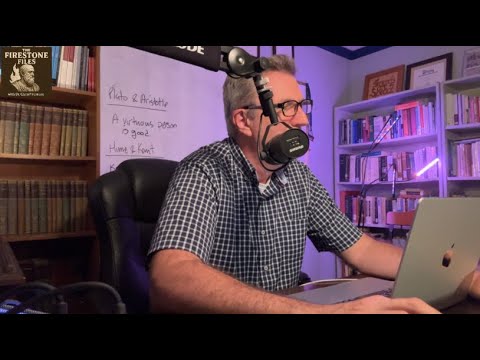
Uh today on this Firestone Files, I'm going to be delving into the question of human identity, human identity. Who am I? Who should I become? And why become a philosopher? That's today on the Firestone Files. You can look behind me and see Plato's cave up on the wall. I'm not sure how clear that is. I'm going to get better at the visuals of these as I go forward, but just a simple picture of Plato's cave. I want to put that there because it says something about the kind of philosopher I am and how we're going to address the question of human identity.
And that is essence. The things that really persist, the really real are beyond just these physical realities that we experience or the appearance of things to us. And that's what Plato's cave is going to be about or teaching us. Our starting point for thinking about our identity lies behind the appearance. So who am I? Who should I become? I'm going to talk about this both from a philosophical vantage point and from a Christian vantage point. going to give you some personal stories of how I became a philosopher and then some key takeaways um that we will bring into the subsequent episodes. Uh first of all, let's start with a Christian perspective.
A number of people in certainly Christians and the church will point to the imo day, the image of God being uh found in all human beings as being fundamental to our identity. I I would suggest to you that that does in fact give us eternal worth or eternal value. If you believe that God created you and he created uh male and female in his image, that secures our eternal worth and our value in the here and now. But it doesn't, I would suggest, fully answer the mundane identity questions. To get answers to those questions, we actually have to look a little bit further in the Genesis story. And ultimately, we'll have to look at the person of Jesus Christ. Uh I'll probably get to the first of those and less so to the second of those in this episode. And we'll take on the uh Christlikkeness uh question some other time.
um in terms of identity or what I'm going to call mundane identity. You see, it's one thing to have this global or worldly or or or divine perspective that we're made in the image of God. It's another thing to know who you are in this world in which you find yourself. I would think and I would suggest from the Genesis account in chapter 3 basically that there are two major points of orientation for us for securing our earthly or mundane identity. For men, there's a vocational tie to personal identity. We see this in the Genesis uh curse after they've eaten from the uh tree of life.
And then God judges them and says that men will toil over their work and they'll have to really work hard to make ends meet. Hey everybody, this is Dr. Chris Firestone. I want to interject here for one brief moment. I said that Adam and Eve ate from the tree of life. If they actually ate from the tree of the knowledge of good and evil, this is an important theological distinction. Um, had they eaten from the tree of life, they would live forever. Uh, had they eaten from the the tree of knowledge of good and evil, they disobeyed God, and this brought death and judgment.
And God pushes them out of the garden of Eden precisely because if they ate from the tree of life in their current fallen state, they would never have any hope. They would be forever in that state. But as we know from the rest of the biblical witness, God had a plan for their redemption to overcome their uh their mistake. So that is an important point. So let's get back to the show. Just keeping that in mind.
So men are deeply involved in vocation in order to discover and sort of congeal their own personal mundane identities. Women were judged with pain in childbearing and desire for their husbands and these relational components are more gerine if you will to the female psyche. Now just a quick side note on this. I would not suggest that these are rigid identities where men are purely vocational, women are purely um relational. There's quite a bit of overlap and I think some of the stories of my own career, my vocational career being highly relational are um are proof of that or at least anecdotal proof of that.
So I'm not suggesting that men are 100% vocational, women are 100% relational, could be 75, 25 likely to be different in different cases, but men tend to gravitate towards vocation and job and work related identity issues and women tend to gravitate towards relational identity uh issues. So, let me tell you a little bit about my upbringing and then my turn to philosophy to try to sort of spell that out a little bit. And if you see something in that story that you can identify with with your own vocational or relational uh quests to understand who you are in this world, I'd be just delighted with that. Um, one of the people I think I may have mentioned briefly in episode one is my father. Um, your great-grandfather, Harry Firestone, Senior. I say Harry because that's sometimes what we call him. Uh, sometimes I call him dad. My kids will call him grandpa and so forth.
He was always a bit of a gadfly intellectually at home. He always asked the big questions at dinner table conversations and really just um, how do I put it? Loved the big mysteries. He loved the JFK stories, the pyramid stories, God and angels, always asking sort of what I would call the paradoxical or harder questions. And uh you know, I think it sort of built within me a kind of fearlessness for taking on these questions. A lot of people, especially uh people of uh what I would call a more rigid faith or a folk faith or or or or a dogmatic faith, um get worried about these questions on the edges because they're really some of them don't have obvious answers to them.
I think some of them do have answers and some of them must remain paradoxes. But for whatever reason, we delighted in talking about these things around the kitchen table. um they remain questions that still I mean my dad is at the time of shooting is 87 years old and he still likes talking about the big difficult questions the ones that uh are hard to for anybody to answer things ranging from you know how many angels could God put on the head of a pin to u you know other kinds of questions you know about UFOs or about I don't know all sorts of different things that are mysteries in life, but in interesting dinner conversation items.
Um, in short, my dad and my mom really encouraged intellectual curiosity, thoughtfulness. They took us to church once a week. We did pray at meals. It wasn't exactly, you know, um, deeply moving, you know, but but we weren't afraid of the bigger religious questions, and that was sort of ingrained in us. um at the earliest ages. Um I put on the board behind me Plato's cave because I think it exemplifies a truth that I have come to embrace as a philosopher and as a person really. Um, and that is, you know, that the way things appear, the physical realities that confront us every day, they can be daunting. They're important. They're they're really real.
You don't want to walk in front of a car cuz that reality will take you on immediately. Uh, all of those things can be true. But some of the most important things, what Plato calls ideas that he takes by the way to be the really real and that this stuff that we're experiencing all around us here is fleeting. It's contingent. What's here today is gone tomorrow. But for Plato, what endures is the form or the internal idea that that's the picture of Plato's cave.
Uh, we're going to probably do a deeper dive on Plato's cave and Plato's philosophy in general at some other time, but I mention it here because the Plato's cave analogy shows us that the most important things in life may not be what sits right in front of you, but what lies behind it. uh the sunlight is the ultimate form and then there are other things that are there that animate the physical appearance if you will. What matters most in life is often not tables and chairs and and and formulas and so forth, but it's things like love and justice and truth and goodness, virtues like courage and compassion. Notice how none of those things can be seen with the naked eye. I can't just point to you know now there's love not without understanding what is below the surface what's behind the appearance.
No one I would argue would die for a table or chair or any kind of physical reality but they might die for their honor or for dignity or for God. And that's true universally among human beings so far as I know. Um the most important things in life are not physical but are metaphysical. And Plato's cave is an analogy. It's a story meant to show that the most important things are eternal ideas or forms and not their individual manifestations. Those things will come and go. Things Plato those things are contingent. Those things are like shadows on the wall. And uh but the really real things, the eternal truths last forever.
Now I was uh with my wife Beth in Ireland um a couple weeks ago and I saw signs of ancient human ruins, castles and abbies, burial places and so forth. The physical things don't endure, but the symbols of more eternal things, the Celtic cross, for example, that we saw in one of the in one of the u um you know, burial area cemeteries, those things symbolize deeper eternal realities that never fade away. What's so brilliant about visiting some of these places is, you know, are the various um artifacts that you can find that testify to that truth.
You know, when you think of the cross, you think of two opposites colliding with one another. the ignominious and torturous death of Jesus Christ and then the resurrection to new life that the empty cross, the Celtic cross represents. Those things are eternal as it were. And so one of the core lessons in all of this is that our identity fundamentally is wrapped up in our essence in our relationship to God and that sort of foreshadows um turning to Jesus Christ and the New Testament and so forth. However, there is this other component about how your mundane work is on mission with regards to some of those virtues and values.
Um, now I didn't come to this when I was 5 years old or 10 years old. I think I had a kind of intuitive a intuitive awareness of it that there were the most important things were beyond the physical. But that took some thoughtfulness, some discovery, some formal study. You know, I entered the university and it was there that I was quickened in my thinking about philosophy. The word philosophy uh phileo means brotherly love and Sophia means wisdom, the lovers of wisdom. And it was in a philosophy of religion class in particular. I was a math major at the time.
I took this philosophy of religion class with a professor named Robert McKim and it raised a lot of these big questions about God's existence, the problem of evil, God's hiddenness, faith and reason and it just went on and on and for the first time personally I had discovered a course dedicated to talking about some of these metaphysical conundrums matters that were so important that people were willing to live and die for them but contentious enough that we have to have a class to discuss the various ways one might approach these difficult questions.
I remember I did my first research paper for Dr. McKim. It was on the ontological argument for the existence of God. I remember I got an A/ minus on it and and it had letters or it had a couple words written on there that resonate in my thinking even to this day some um 40 years later. Yeah, I suppose that's right. Anyway, he wrote, "Well done. I believe that you may have an aptitude for this sort of work." Something like that he wrote on there. That was the first time another person, another man, another uh person of authority had told me I was good at anything.
I mean, well, that's not totally true. I had some things in high school that I was good at. You know, I'll share some of those stories along the way, but this was something that really mattered to me and somebody took notice of my sort of aptitude, interest, passion uh for this potential uh work. And I say work because it's in the vocation that I I was looking for a vocation. I was a math major. I was sort of technically good at math but not really interested in it theoretically or fundamentally. But it was at philosophy where I found something that really uh uh animated me and my passions, my interests vocationally.
and uh Robert McKinn asked if I would be interested in doing a senior's honors project with him and I did it on a topic that came up in that course called the topic of the hiddenness of God and that particular project the hiddenness of God became a platform or a a a starting point for me intellectually that I'm still on 40 years later. It set my academic trajectory and I'm going to, you know, try to explain a little bit more about how that happened. So, um, here I am at the University of Illinois studying mathematics and philosophy and Robert McKim comes along. He gives me some confidence by believing in me and giving me some guidance.
He thought uh in fact he he advocated for me to go to the same school he went to for a master's degree once I was finished. He knew that my work in math was mediocre. Well, you know, it's like a B range, you know, but my work in philosophy had risen up to the A level and Robert and Kim said, "Man, you've got some possibilities. Uh, Mr. Firestone, uh, why don't you go to Yale and do a master's degree?" That's where he went. he thought he had some contacts there and could get me into that program.
I wasn't sure I was ready for that. Uh I was still somewhat unrefined. I still didn't have the money or the direction or the or the leadership beyond Robert McKim to go in that direction. So I started asking around my mentors and other people like where should I go for a master's degree? And the re the thing that was driving me at that time was the bifurcation in my soul between faith and reason. I know I'd studied Robert McKim and I'd studied, you know, philosophy of religion and metaphysics with Robert McKim, but most of my philosophical mathematical training were with people who I took to be agnostics or atheists.
People who didn't really have a religious inclination. and they had sort of technical sort of instrumental aptitudes in philosophy and math but didn't really have any what I would take deep religious spirit and so I was a churchgoer I was um you know felt compelled to believe and to follow my faith and so here I have this philosophical training this church training if you will but the two didn't really overlap or or integrate very well so I started Ed asking some people.
There was a fellow named Dr. not doctor. He's actually a high school coach. Uh Larry Stillwell. He's my chess coach in high school. And Larry said you should consider a school called Trinity Evangelical Divinity School. If you want to do a master's degree where faith and reason are questions that are central to what they were all about. Well, I went up to Deerfield, Illinois. It's like a 30 minute drive.
I didn't honestly had never heard of Trinity Evangelical Divinity School at that time, but I went up there and I fell in love with the environment and I thought, "Yeah, I think this could be a place for me to stick around for a couple of years and work out some of the issues of faith and reason that I was having." While I was at Trinity, a couple of different professors, Dr. Harold OJ Brown was fundamental to my experience there. I had started in the program doing okay taking classes and meeting different professors but it was in my project the uh what they call the MA thesis that I began to struggle. I had a another uh professor called John Fineberg and he kind of uh didn't like my approach. Kind of tore me a new one if you will on my first attempt to write a chapter for my senior not senior my uh my master's thesis.
And I there was so much red on that paper that it kind of knocked me out of commission for three months or so until I went into the office of Dr. Brown. They used to call him Joe. That was his I guess that's the J in Dr. Harold OJ Brown. Um he looked at my work and I remember going into his office. I'd been sort of paralyzed for three months trying to figure out what to do and trying to recover from my first attempt to write a chapter and he said, "Chris, I want to tell you that this chapter was not very good, but I think I see what you were trying to do.
Let's sit out. let's sit here and try to figure out a way forward. So, we sat in his office at first, then we walked outside his office and sat in the hallway. And at that time, one thing I'll never forget about Harold Brown is he gave me a cookie. He was like, Brown never turned on his office lights. So, we sat there for a few hours talking through the thesis and we we it got darker and darker in his office. And um uh it was in that experience with Harold Brown that um I came to a new focus on what I was going to do. I was going to do uh something on the hiddenness of God and Lutheran thought that is uh the person Martin Luther and his writings.
And that changed my trajectory. His mentorship and his leadership and his seeing something in me meant everything to me at the time. It was about during that same time where I saw another professor, his name is Clifford Williams or Cliff Williams. We always everyone calls him Cliff. Um, I saw him riding his bike on the campus and I had this Eureka moment on my master's thesis, but I also had this vocational Eureka moment when I saw Dr. Cliff Williams. I said, I asked, "Who is that guy?" He goes, "He's the philosopher here at Trinity." I said immediately to myself. It was like a click moment, I want his job.
That was a I know there's a little pretentious. I'm here. I am don't even have a master's degree, but I'm saying I want that guy's job someday. Well, um I'm going to just bracket that for a moment. I don't know what it was about him. It was the carefree academic lifestyle, the the the culture of academia, the ability to teach and to study and to mentor. All of those things animated me and I saw something in him that I wanted. I wanted to become like Cliff. So, the combination of Harold Brown and Cliff Williams gave me both content and form, if you will.
It was then I met another guy and this guy would become absolutely crucial to my eventually getting a PhD and his name is Dr. Kevin Vanhuser. We just call him Kevin. So we have Joe Cliff and Kevin. Who would have thought it? Anyway, Kevin was a professor at Trinity. I took a class on Emanuel Kant with him. Very few people knows that Kevin Vanhuser uh once taught the philosophy of Emanuel Kant. I think he taught it that one time and never taught it again. Um, he then while I was trying to finish up my master's degree got a job offer at the University of Edinburgh and he left Trinity, but he left this indelible impression on me.
And I'm going to come back to Dr. Vanhuser here in a moment. To make a long story short, at Trinity, I was able to get my master's thesis finished. I got a good grade on it and um really sealed the deal on that. Um master of arts in Christian thought emphasizing philosophy of religion. I then got married during that time. That's a whole another story to tell at some point. But my wife and I um decided that we needed some time to work off our debts and to travel a little bit. So we looked around the world where we could be in service to the church, work off our debts and see a little bit of the world.
Believe it or not, I I to this day it's not totally clear how this happened. It was kind of two things that came together providentially. We landed in Hong Kong. Now this was British Hong Kong before it was handed over to China in 1997. The time I'm talking about right now is 1993. I have a master's degree. She has a bachelor's degree in education. She had met the principal of the International Christian School um at a job fair at Trinity. And so she had a kind of Hong Kong connection even though it was pretty lightweight at that time. I knew some people who were doing a who were preparing to go on a summer uh missions trip to Hong Kong.
So, the combination of those two got me wondering whether or not Hong Kong could be the landing pad for um my wife and I uh after this master's degree. Now, in order to prepare to answer that question, I decided to take a course on myology. This is like uh the study of how to do missions with a guy named uh Heert. Um, and uh, you know, that's all I remember of his name at the moment, but he was a famous missiologist there at Trinity for quite a while. Anyway, I did my major project in that class on Hong Kong.
So, I learned a ton about Hong Kong, where it was, how many people were there, how many Christians are in Hong Kong, um, you know, all about its commerce and it's it's being a window to China and all of that. At the same time, Beth made contact with that principal and was going through a recruiting process, a hiring process with them. And so, she ended up getting the job offer. And with that job offer, believe it or not, I was given um a work visa so I could work in Hong Kong. The combination of those two things and it being a thriving place of commerce made it kind of a no-brainer to tick all the boxes.
We could serve the church in Hong Kong. We could pay off our debts. We could get lots of teaching experience, which is one of the things I knew that I needed to grow into the vocation that I really wanted to be to to grow into. And uh so off we went. And in 1993 all the way up to around to just before 1997 we lived in Hong Kong. Now there's one more person that I will um that I'll mention at this point uh that that I haven't mentioned yet. His name is Dr.
Steven Pongquist. Met him. He was a professor out in Hong Kong. After teaching a year, After teaching two years uh English and paying off all of our debts, I decided I wanted to go back into the postgraduate and I mean, you know, graduate school, post-graduate work in Hong Kong. And so I asked around and I got to meet this guy, an American professor working in Hong Kong studying the philosophy of Emanuel Kant. Now, she was an interesting find for me because as I mentioned before, I had studied the hiddenness of God and then I had studied the Lutheran version of the hiddenness of God in my master's degree.
Now, I've encountered this philosopher who some people call the dethizer of Luther. I won't explain all that right now. I I could talk about Khan for for a long time since that was my PhD topic, but Steven Palmquist seemed like the natural trajectory for me to get back into philosophy, studying the philosophy of Kant and the question of God in the uh in the PhD level with a Lutheran philosopher, the philosophy of Emanuel Khan. So uh I was able to study with Dr. Palmquist for a year or two uh on this in this same in the same vein.
Now um this all of this to say that my vocation was a series of say providential kind of click moments. The first one came in undergraduate where I discovered a class philosophy of religion and a professor who believed in me who thought I could be a philosopher. And then when I went on to the master's degree, Harold Brown and um Cliff Williams and Kevin Vanhuser made that pathway clearer and clearer to me. And then when I went on to the PhD, Steven Palmquist came back uh came into the picture and he sort of crystallized that image of what a philosopher is and could be.
uh he was he was a great a great uh mentor to me at the time and um made a big impression on me about what I could become. Now things don't end with Dr. Steven Palmquist because because of the handover in 1997 I had to leave Hong Kong. I guess I didn't have to but everyone at the university was uh I don't know what you would call it warning me or advising me to leave.
even so I started to look for a place to go to finish my PhD and this is where Dr. Kevin Vanhuser comes back in the picture because I was I remembered on my on my uh flight back to the US once that I said hold on I know a guy in the British system I was in Hong Kong studying with Steven Ponquist at the university uh in the in graduate school. I said I need to transfer to another British school. Who do I know in the UK? And it dawned on me that Dr. Kevin Vanhuser, who I had had at Trinity, was a professor at New College in Edinburgh in the UK.
So, I wrote this postcard to him, and I didn't even spell the university correctly, but I I gave him I think it was my email address at the time. Now, email wasn't the thing it is today. Um, monochrome screens, unreliable internet, all of that kind of stuff. But after about a month, I heard back from him that my message in a bottle had arrived.
And so um he invited me to apply for the PhD program based upon some of my previous work in Hong Kong and um and our relationship and my interest in studying Kant and theology because remember he taught Kant at Trinity and he's also a worldrenowned theologian and I thought the two coming together would be the perfect place for me to go. So after some uh working with that um I um I decided to go ahead and go along and do that and um and I went to uh Edinburgh, Beth and I stayed there almost three years and I did finally achieve the PhD. I'm going to do an entire podcast, probably could do multiple ones on how I actually arrived at the PhD.
It was a three-year program that took me nine years to complete. I'll just give you that as a teaser. But the reason I was able to stay the course was because I felt God had a call on my life and that I was vocationally driven to complete this thing. I knew that's who I was and that's where I was supposed to go and by God's grace I was going to do everything possible to get there. You cannot you cannot know who you are. You cannot choose your vocation just randomly. You have to choose it with conviction, with passion, with understanding who you are and how God has uh wired you and placed you in this world.
And I honestly were many times along the way where giving up felt like a strong option. And yet there was something deep in my soul that said, "Chris, keep moving forward. Keep moving forward." Um well um I mention all this because um of our original question. Our original question is who am I and you know um who should I become and why would I become a philosopher? Honestly, I think that my story of becoming a philosopher is analogous, potentially analogous to you becoming anything specific. I don't know about you, but I feel anxiety anytime I cut off other options and go in one direction. That may be a fault of mine, but I think everybody feels that to a certain degree. When you pick one thing, when you go down one road, you're implicitly eliminating other possibilities.
It's really important that you know yourself and you know what the call is on your life. You know what is it that animates you and do you have the requisite mentors people who kind of have been down those roads who can help you to get there. Maybe these are kindred spirits in one way or another who have gone down that pathway and can help you to get there. You can't do this kind of thing alone. Particularly if it's aspirational. You know, a PhD is a terminal degree. It's the highest degree human beings can offer in this world. And in order to complete it, there's going to be blood, sweat, and tears.
If you are a firestone and if you have a call on your life to go in some direction, I don't know care if it's athletics or it's intellectual pursuits or it's religious pursuits or anything. It's going to take holistic wholehearted mind, body, and spirit effort to get there. And you can only do that if in fact you have a passion, you have a a click moment, if you will, where you recognize, like I did with Cliff Williams, that that's the job for me. That's why I was meant for this world. Um, then I would say go for it and uh and uh don't stop until you get there because you were meant for that. God put laid that on your heart and why not why not go there?
Well, all of that, you know, all the great ideas, studying the philosophy of Emanuel Kand, all the contributions I've made in scholarship and in the classroom and so forth. Interestingly, very few of those things are physical realities. More importantly, they speak to immaterial realities. We model lives on those who carry eternity in their hearts. And those people that I mentioned along my way, they were like, I don't know, um, guides for me to help me, propel me. Every time I was in a valley, they would sort of lift you up and say, "You got this, Firestorm.
Keep going." Ultimately, our personal decisionmaking is guided by these kinds of mentors, by our faith convictions and the philosophical pursuit to understand God, the world, and ourselves in order that we might get there and become who we were meant to be. Um, I don't know if that's helpful to you. Uh that's a little bit of my story and why I think this is important. Why would anyone want to become a philosopher? Honestly, there's two answers to that. One is that everybody already is a philosopher. I've argued that at least in part in episode one, but I I'm sure that uh that's going to come up again.
Everyone asks the big questions at some point or another in their life. And yet those big questions um for the philosopher become kind of central to everything we do and everything we think about and everything we teach to others. Um as one of my favorite philosophers William James one put once put it philosophy uh uh addresses the questions to which there have not been satisfactory answers by those who've asked them. In other words, the open-ended questions are kind of what philosophers do. But as we close off those questions, we gain knowledge, we gain self-standing, and we gain perspective on life. And everybody everybody does this.
You know, I've one of the things I really loved when I was living in Deerfield um for 25 years was those block parties cuz I'd go out there and we'd have all sorts of vocations represented among the men there. But they would always gravitate to the philosopher asking the big questions. These are questions everybody's asking. They wanted to know what my perspective was on the issues. That was like an annual event at our block party. Um, and there's good reason for that because philosophers kind of been there and done that. They don't necessarily have all the answers, but they know what's misdirected. They know what's offc course typically. And then they have their own faith convictions which drive them and help them to see a little bit further and farther than most people.
You know, I would make the case that my Christian convictions help me to see a little bit further and farther than those of other faith convictions. But, uh, that's a story perhaps for another day. Um, and we're going to keep pressing on as we go along. I'm hoping that that was helpful to you. Uh, I'm Chris Firestone. This was the Firestone Files. Have your book. Thanks for stopping by to spend some time with me here on the Firestone Files. I hope today's reflections offered you some new insights and perspective on Bible. If you enjoyed the episode or found it valuable, I'd appreciate it if you'd take a moment to like, subscribe, and share it with someone you care about.
I'd also love to hear your thoughts. What resonated with you? What challenged you? Or what would you like to hear more about in future episodes? Drop a comment below or send in your suggestions to the email in the description. Your input helps shape where we go next. This has been Dr. Chris Firestone. Until next time, keep asking the big questions and remember the kingdom journey is always best with your friends. Further up and further in. Bye for now.
Auto-generated from YouTube captions and lightly formatted; it may contain errors.
Related episodes
More from Mind, Heart, and Body, then the nearest by date.
 Mind, Heart, and Body44:03
 Mind, Heart, and Body47:00
 Mind, Heart, and Body51:47