
Author · In progress
Immanuel Kant: A Companion to His Philosophy and Its Theological Reception
A one-volume introduction to Kant for the thoughtful reader, and to what theologians have made of him. In draft.
Written for the thoughtful reader who wants to know Kant better, this book sits between the "rarely read" volumes of the Kant guild and the "often read" beginner's guides that flatten Kant into disconnected definitions. In place of the "instruction manual approach" it takes an "illustrative approach," reading Kant chronologically and through metaphors from contemporary life, and presents his philosophy as a multi-perspectival critique of pure reason: one coherent system that must be read whole rather than truncated at the first Critique. Part One covers Kant's career, his critical writings, and his vocation as a pure philosopher; Part Two treats the three Critiques through "What can I know?", "What ought I to do?", and "What may I hope?"; Part Three turns to the philosophy of religion, Christian theology, and Kant's final question, "What is man?", which the author argues is answered in rational religious faith.
Draft manuscript. Chapter summaries and the excerpt are from the working draft the author shared; details may change before publication.
From the preface (draft)
There are too few volumes on Kant’s philosophy written specifically for the thoughtful reader who merely wants to know Kant better, without being overly simplistic or idiosyncratically complex. Such a book would be accessible yet sophisticated, covering the full range of Kant’s philosophy charitably, with enough of the essential Kant to be intelligible and respectable, but not so much that the reader gets lost in the proverbial forest because of the trees. This present volume is written with this group in mind; it is neither for the philosophical novice nor for the Kant expert, but for the intelligent connoisseur of modern thought who wants to be conversant with Kant. Think of this book as one might think of a helicopter tour of the Grand Canyon. We are going to travel from an obscure, incomplete, and distant vantage point to a place closer to the action without risking dehydration, scorpions, or being swept away by the river. In other words, we will strive to experience Kant with clarity, coverage, and just enough complexity to understand Kant well. We will see a lot, but without detail-overload typical of most books on Kant. If the reader experiences one or two eureka moments, particular insights due to a better understanding of what Kant actually holds as key aspects of his critical philosophy, or a better sense of how these various aspects work together to form one system, the book will have achieved its purpose.
— Chris L. Firestone, from the draft preface
Chapter by chapter
- Preface
Contrasts scholarly Kant books almost no one reads with popular guides that oversimplify him, and offers this volume as a "helicopter tour" between them. Names the connective concepts the book will stress (critical method, Copernican revolution, needs of reason, God, freedom, immortality) and uses two public debates to show Kant misused, arguing he is a moral objectivist opposed to naturalism and atheism.
- Introduction
Sets the "illustrative approach" (metaphor plus chronological reading) against the "instruction manual approach," and pictures reason as a "processing plant" whose workings Kant is first to open. Distinguishes "What can I know?" from "What do I know?", lays out the book's three-part plan, and previews the claim that Kant's system culminates in a rational anthropology found in rational religious faith.
- Kant's Philosophical Career — A Brief Overview of Kant's Philosophical Career and Its Influence
Sketches Kant's life (Pietist upbringing, the 1770 professorship, the Inaugural Dissertation, the silent decade) and separates the critical method, used throughout his career, from the Copernican insight that defines the critical period. Criticizes truncated one-part and two-part readings (Mendelssohn's "all-destroyer"), points to the "room for faith" passages, and calls reason's employments human "superpowers."
- Kant's Critical Writings — Kant's Critical Writings and Their Significance
Surveys the six main critical texts and the censorship under Wollner, arguing the religious writings are not political concessions. Explains the first Critique's Doctrine of Elements and Doctrine of Method, the "island of truth" and "stormy oceans" images, the four questions, and Kant's analysis of "reason unemployed," and states the aim of going through Kant toward rational religious faith.
- Kant the Philosopher — Kant's Calling as a Pure Philosopher and Its Implications
Argues that reading Kant as a pure philosopher, per The Conflict of the Faculties, rather than as "Kant-the-person" or "Kant-the-politician," explains his late theological writings and the "necessary conflict" of philosophy and theology. Develops hermeneutical aids: guarded optimism (via "Trials in Theodicy," "The End of All Things," and the Opus Postumum, engaging Palmquist), transition versus transformation (against Green), and hermeneutic versus hermetic holism.
- What Can I Know? — The Power of Immediate Sense Perception and Thinking
Places Kant at the end of the modern turn to epistemology and its unsolved problems of causation and substance. Explains synthetic a priori knowledge as a "third form of knowledge," space and time as forms of intuition, and the twelve categories as forms of conception (theater and black-and-white TV analogies). Covers the thing-in-itself, the case against the ontological and cosmological proofs, and God, freedom, and immortality as problems for the later Critiques.
- What Ought I to Do? — The Power of Discerning Good and Evil (and Acting on It)
Presents the practical philosophy as a "second revolution" in which freedom, tethered to the moral law as its highest incentive, becomes known and acts as a new cause in the causal nexus. Explains the predispositions to animality, humanity, and personality as a pyramid of incentives, categorical versus hypothetical imperatives, the lying case, evil as inverted incentives, and God and immortality as postulates needed for moral stability.
- What May I Hope? — The Power of Appreciating Beauty and Purpose (and Creating It)
Describes the "wobble" between theoretical and practical reason (the fact-value divide) and Kant's turn to aesthetic and teleological judgment: the four moments of beauty, beauty versus the agreeable and the good, the purposiveness of organisms, and Kant on the poet. Concludes that the third Critique offers only a partial solution, contrasting the philosopher's "poetic possibility" with the theologian's "religious actuality."
- What is Man? Religiousness A — What is Man? (Anthropology from a Pragmatic Point of View and Religion within the Boundaries of Mere Reason)
Examines Anthropology from a Pragmatic Point of View: what "pragmatic" means, how its three books mirror the three critical perspectives, the closing section on the character of the species (man is destined to cultivate, civilize, and moralize himself), and Providence as ultimate teacher, in dialogue with Kaufman and Green. The sections on rational religious faith, Christianity, and "Religiousness A" are headings only in this draft.
- What is Man? Religiousness B — Theology on What It Means to be Human
Works through Religion within the Boundaries of Mere Reason: humanity evil by nature but not by necessity, the divine-human prototype and a three-part "anatomy of moral hope," ethical communities, and the test of New Testament Christianity. Then treats the Canon's distinction of knowledge, faith, and opinion, "What is Orientation in Thinking?", and the cognition/knowledge (Erkenntnis/Wissen) distinction via Rolf George and the Byrne-Wiebe-Luik debate.
- The Implications of Kant's Philosophy for Christian Theology — The Future of Kant's Philosophy and Christian Theology
Offers a typology of Kant's theological reception: atheism, agnosticism, and non-realism; deism as fulcrum; and Green's two-realm, Davidovich's three-realm, and Palmquist's four-realm readings. Sets out Kant's view that philosophy and theology are in conflict but "not a war," summarizes the four Books of Religion, presents Yandell's evidence that Kant's stated views on incarnation, resurrection, and Trinity are unorthodox, and asks whether these are final judgments or provocations for theologians.
Recurring themes
- Kant as a pure philosopher analyzing "reason unemployed"
- Reason as a "processing plant" and the Copernican insight (synthetic a priori)
- The four questions (know, do, hope, man) as the architectonic of the critical philosophy
- Reason's employments as human "superpowers": knowledge, morality, beauty, faith
- Read the whole, not the part: against truncated one-part and two-part readings of Kant
- Guarded optimism, perspective, transition, and the whole as hermeneutical aids
- God, freedom, and immortality as needs of reason grounding rational religious faith
- The "necessary conflict" of philosophy and theology (The Conflict of the Faculties)
Episodes that discuss this book


Cite this book
Firestone, Chris L. Immanuel Kant: A Companion to His Philosophy and Its Theological Reception. Cascade Books, forthcoming.
More books
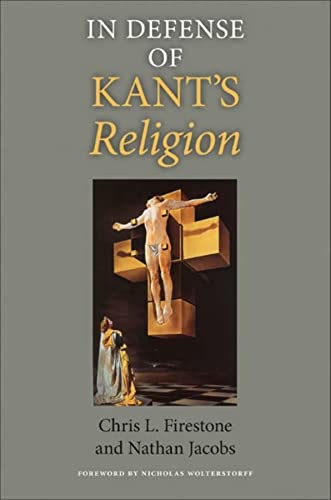
In Defense of Kant's Religion
2008 · with Jacobs
Kant and Theology at the Boundaries of Reason
2009
Why Does Friendship Matter?
2021 · with Pierce
Kant and the Question of Theology
2017 · with Jacobs, Joiner
The Persistence of the Sacred in Modern Thought
2012 · with Jacobs
Kant and the New Philosophy of Religion
2006 · with Palmquist